


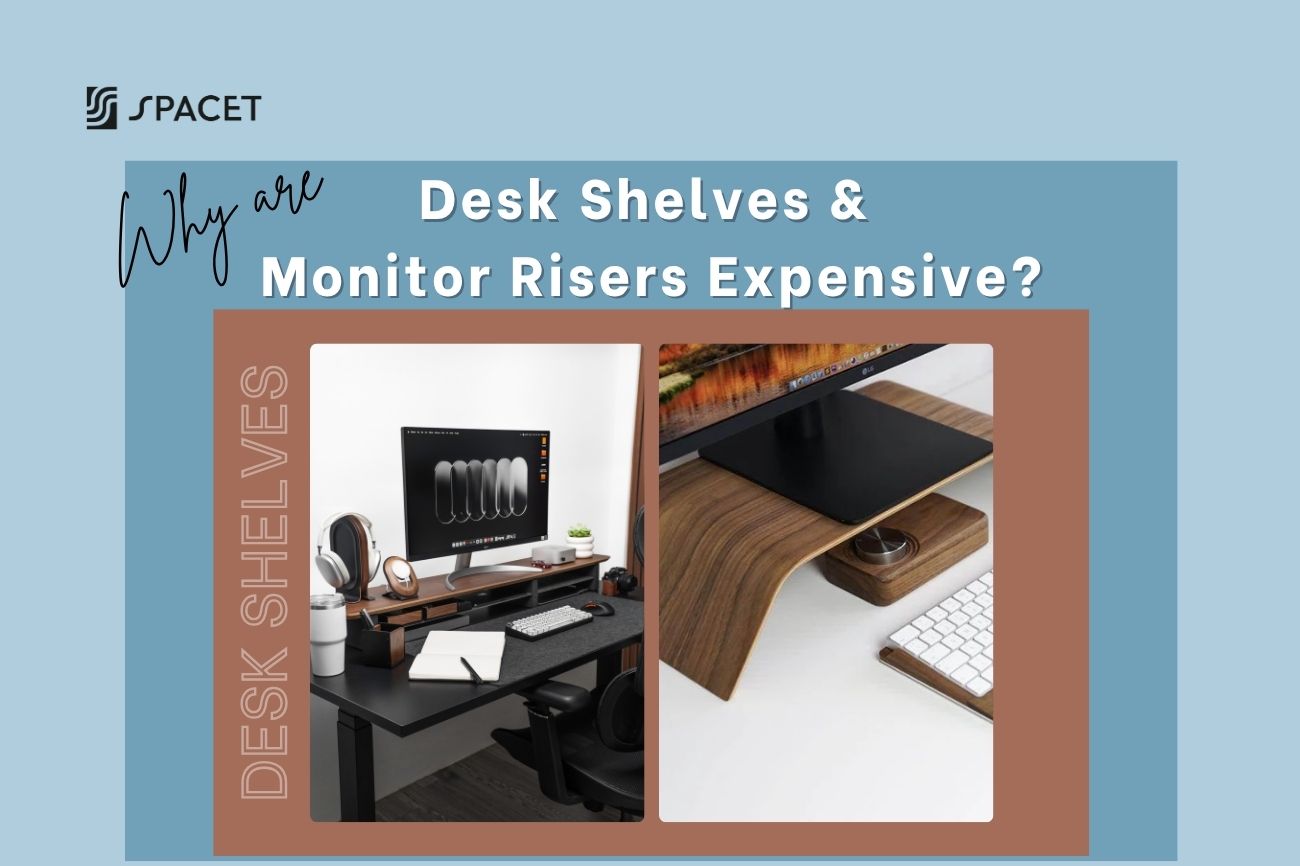
You search for a desk shelf, spot a price tag of $150, $200, even $300, and your first reaction is probably: wait, is this thing made of gold? Totally fair. It's one of the questions the team at Spacet gets asked most often. So instead of dodging it, let's talk straight: why are desk shelves and monitor risers so expensive, and whether that price is actually worth it.
What Are Desk Shelves and Monitor Risers?
A desk shelf is a raised platform that sits directly on your desk, lifting your monitor to a better height while creating useful storage space underneath. A monitor riser is the simpler, more compact version, a small stand designed to bring your screen up to eye level.
Both solve the same problem: most monitors sit too low when placed flat on a desk, which means you're subtly craning your neck for hours every day. That's one of the top causes of neck and shoulder pain for office workers and remote workers alike. So no, this isn't décor, it's a real investment in your health and long-term productivity.
So Why Are Desk Shelves and Monitor Risers So Expensive?
Let's break it down, one layer at a time.
1. Materials - The Gap Between $20 and $200 Starts Here
A $25 desk shelf from Amazon gives you MDF wrapped in thin veneer, plastic screws, and hollow legs. A $200 one gives you real wood, walnut, oak, maple, paired with solid aluminum that's been CNC-machined for a precise fit. The difference in feel and durability is immediate. One warps or chips within a year or two; the other looks just as good a decade later.
A good example: Spacet's Desk Shelf System uses 15-ply premium hardwood plywood, 15 layers of hardwood pressed together, rated to hold up to 100kg without bending or warping. Add industrial-grade aluminum, natural cork, and Merino Wool felt to the mix, and you're looking at materials that cost real money, especially when sourced from quality-verified suppliers.

2. Design and R&D
People often think a desk shelf is just "a plank with two legs." But getting the proportions right, beautiful and ergonomically sound, takes a lot of deliberate work. The height needs to put your monitor at the correct eye level. The depth needs to fit a keyboard underneath without feeling cramped. The weight distribution needs to be balanced so nothing wobbles when you're typing hard.
Spacet started with a clear design philosophy: "great design is about balance, between form and function, beauty and purpose.” From the first concept sketch to the final prototype, every curve, angle, and texture is thought through carefully, so the end result isn't just nice to look at, but genuinely comfortable to use every day. That R&D process has a real cost, and it shows up in the price tag.

3. Handcrafted with attention to detail
Premium workspace products aren't made on a generic factory line. Each wood panel is checked for grain consistency. Every aluminum joint is tested for fit and finish. Every surface is carefully refined before the product gets boxed up.
That attention to small details is exactly what separates a product that looks good in photos from one that feels great the moment you hold it. Spacet customers often say the real thing exceeded their expectations compared to what they saw online, and that kind of reaction doesn't happen by accident. It's the result of quality control that takes time and care.

4. A Long-Term Investment in Health and Performance
A good desk shelf or monitor riser is an ergonomic product built to protect your neck and spine over years of daily work. Screen at eye level means less neck strain, less shoulder tension, less mental fatigue from physical discomfort. Over five or ten years, the savings on pain relief, physio appointments, or just lost productivity from discomfort adds up to far more than the price difference between a cheap shelf and a good one.
There's another angle that often gets overlooked: a well-designed, cohesive workspace genuinely improves creative thinking and focus. That's the reason Spacet built Premium Collection 2.0 as a complete workspace system, desk shelf, monitor stand, laptop riser, desk tray, all in the same 15-ply hardwood and the same design language, so your setup feels intentional rather than thrown together.

If you prefer something more flexible and modular, the AIRY Modular Collection lets you expand and customize your workspace over time.
5. The Honest Reality: This Is a Niche Market, and Pricing Reflects That
Premium desk shelves aren't for everyone, and the price reflects that honestly. The workspace accessories market is still small compared to mass-market furniture. That means fixed costs, warehousing, specialized packaging for wood products, logistics, 14-day returns, customer support, get spread across far fewer orders than a major furniture brand handles.
That's why you can't expect premium desk shelves to be priced like IKEA flat-pack. And if something looks "premium" but costs suspiciously little, that's usually a sign to look more closely at the materials and finish quality.
The Honest Comparison: Cheap vs Premium Desk Shelves
| Criteria | Budget ($20-50) | Mid-range ($80-150) | Premium ($180-300+) |
| Materials | MDF, plastic | Basic wood, thin steel | Real hardwood, solid aluminum |
| Durability | 1-3 years | 3-7 years | 10+ years (lifetime) |
| Weight capacity | 10-20kg | 30-50kg | 100kg+ |
| Aesthetic | Generic | Decent | Premium, photogenic |
| Ecosystem | None | Limited | Full system |
| Cost-per-year | Highest | Mid | Lowest long-term |
When you calculate cost-per-year, premium often wins. Buy a $30 shelf and replace it every two years, that's $150 over a decade. Buy a $250 shelf that still looks brand new ten years later, and you're actually spending less per year. No replacement hassle, no putting up with something that feels flimsy the whole time.
Desk Shelf vs. Monitor Riser: Which One Do You Actually Need?
A monitor riser is the simpler pick, it does one thing well: lifts your screen to eye level. No extra storage, no extended surface, no fuss. Great for minimal setups, limited desk space, or when you just want to fix the ergonomics without changing much else.
A desk shelf is the more versatile option, it raises your monitor, opens up a whole new surface above your desk, and creates a clean space underneath for your keyboard, notebook, or other gear. If you're building a serious workspace and want everything to feel purposeful, a desk shelf is the natural upgrade.
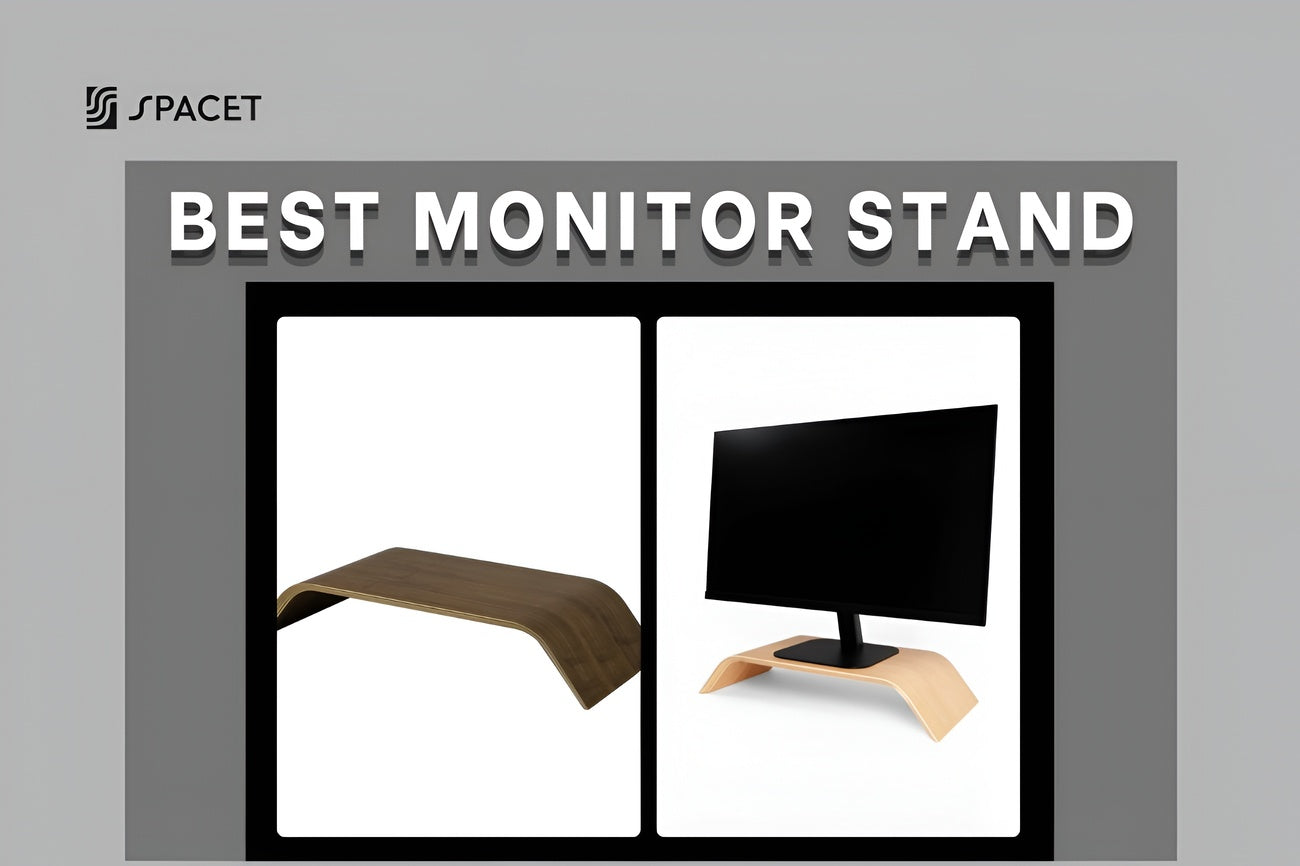
Spacet covers both ends. The Monitor Stand v2.0, crafted from walnut hardwood and aluminum, is compact but still carries the premium feel of Collection 2.0. It's the right starting point if you want an ergonomic upgrade now without overhauling your whole setup. If you're ready to build something more complete, keep reading.

Why Spacet Is Worth a Look
Spacet was founded in Toronto, Canada, with one mission:"bring calm, creativity, and purpose to modern workspaces." Trusted by employees at Shopify, IBM, KPMG, Intuit, Salesforce, etc., across 100+ global companies, that's not the track record of a brand cutting corners.
Spacet has two flagship desk shelf lines, each built for a different kind of setup:
Desk Shelf Pro v2.0: The all-in-one option. An integrated lower shelf comes built right in, making it a complete workspace solution from day one. The Large size (117cm) comfortably fits dual 27" monitors, holds up to 100kg, and is built from 15-ply walnut hardwood with an industrial aluminum frame.

AIRY Modular Desk Shelf: The flexible option. A mounting grid system lets you snap on accessories as you need them, laptop dock, headphone holder, tablet holder, MagSafe holder, no tools required. It's the foundation for a workspace that grows with you over time.

The core difference: Desk Shelf Pro v2.0 is complete right out of the box. AIRY Modular is the foundation you build on over time. Both come in four finishes, Black Walnut, Oak, All Black, White Oak, and are compatible with each other if you ever want to mix and match.
Alternatives Worth Considering
To be fair, you don't have to start with a premium brand shelf. Here are a few other paths:
- DIY with real wood: Around $30-60 in materials, solid results if you have basic woodworking skills. The downside is time, tools, and getting the ergonomic proportions exactly right.
- Second-hand marketplaces: Quality desk shelves hold up well if they've been cared for. Buying secondhand on Facebook Marketplace or eBay can cut the price by 30-50%.
- Mid-range monitor riser: A reasonable place to start if ergonomics are the priority and a full desk shelf can wait.
- Bundle for better value: Spacet's Bundle Saving Program lets you save more the more you add, a smart option if you're setting up a workspace from scratch.
Frequently Asked Questions
Why is a desk shelf so much more expensive than an IKEA shelf?
IKEA shelves aren't designed to sit on a work surface. A desk shelf needs precise ergonomic height, stability while you type, enough depth to fit a keyboard underneath, and often includes cable management. Those requirements make it a fundamentally different product from a standard shelf.
What's the difference between a monitor riser and a desk shelf?
A monitor riser simply lifts your screen, compact and focused. A desk shelf is wider, adds a usable surface on top, and creates storage space below. If you don't need the extra functionality, a monitor riser is the more straightforward choice.
Do desk shelves actually help with ergonomics?
Yes, genuinely. Most monitors placed flat on a desk sit 8-15cm below eye level, which means you're slowly straining your neck all day. After years of that, neck and shoulder pain is a very common outcome. A desk shelf is one of the simplest, most effective fixes for it.
Should I get a monitor riser or a desk shelf?
Limited desk space, minimal setup, go with a monitor riser. Want to reorganize your whole workspace, add storage, and create a consistent aesthetic, go with a desk shelf. Spacet has both, so you can start at whatever step makes sense for where you are right now.
Is a $200+ desk shelf worth it compared to stacking books under your monitor?
Books get the job done for a while, but they don't offer cable management, extra storage, or any integration with accessories down the line. If you're serious about your home office, $200 for something that lasts 10+ years is genuinely good value when you break it down by year.
Conclusion
Why are desk shelves and monitor risers so expensive? Because they're not really furniture, they're ergonomic tools, built with intentional design, quality materials, and a level of finish that mass-market products simply don't match. You're paying for real quality, real durability, and something that shows up for you every single day.
If you're ready to build a workspace you actually enjoy, head over to Spacet and explore the full Desk Shelf System, from the compact monitor stand all the way to the two flagship desk shelves. Every piece is designed to work together, so your setup feels complete rather than cobbled together.
Want more on workspace setup, ergonomics, and gear worth buying? Spacet Blog has you covered.

Compartir: